
Recently Lending Club instituted a new policy concerning investor interactions with potential borrowers. Previously, investors could ask potential borrowers basically anything at all, and borrowers could respond at will. The new policy, presumably done to protect borrower privacy, restricts investor questions to a predetermined, limited, list.
Some investors are outraged. Why? Well, as Peter at Social Lending explained, some investors use Q&A to feel out potential borrowers. The goal of such careful vetting is to determine which borrowers are serious and which are likely to flake on the loan. Many investors used Q&A to explain the importance of Lending Club to investors, and to remind borrowers that investors at Lending Club are real people, not just a faceless bank. And it makes intuitive sense that a borrower that takes time to carefully describe their goals for a loan and detail their expenses will be a better bet than a borrower who acts disinterested or seems confused about their financial status.
So is there empirical evidence to support the idea that borrower descriptions of their loans matter? Lending Club loan data includes any description of the loan by the borrower. It looks like the data includes borrower responses to questions, but I am not certain about that. But there is enough data there for a rough analysis.
Comparing estimated percentage return for all loans, I can break out loans by the number of characters in the description. A very short description indicates that the borrower did not really engage with investor questions or did not try to “advertise” the loan by offering a thorough description of the loan purpose.
 Here is where things get interesting. Each circle represents a loan from the Lending Club data. Most loans result in a positive return on investment, so we see a cluster of loans at the top of this graph. But look at the clumping of loans along the left side. Loans that contain descriptions of less than, say, 1000 characters, are much more likely to show a negative return.
Another way to look at this is to take an arbitrary cutoff of characters. Say we reject all loans with less than 100 characters in the description and invest in all the rest. Is that return better, on average, than investing in all loans equally? The next two figures suggest that it is better to invest in loans with longer descriptions:

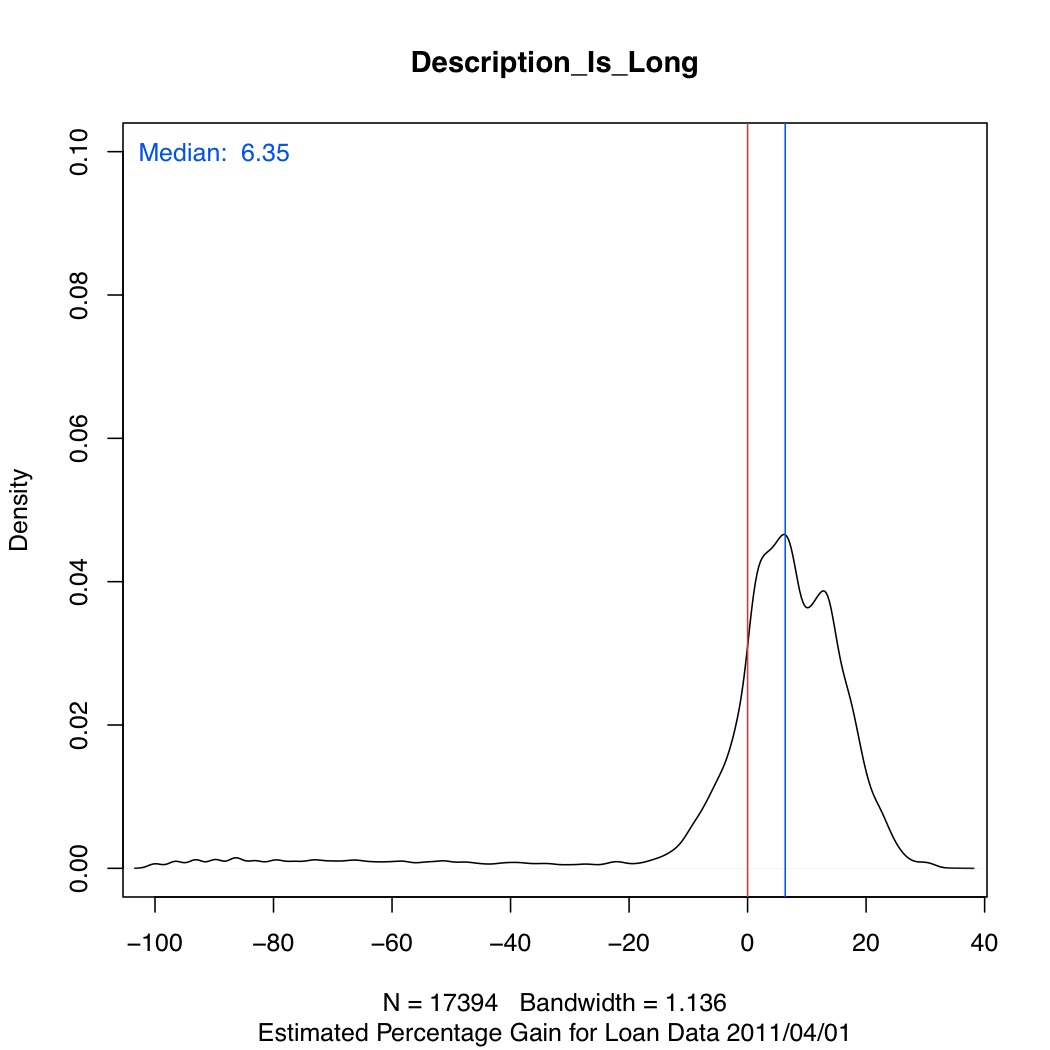
The effect is somewhat subtle, because we are dealing with thousands of loans. But the result is strong: a shift in investment return from 5.12% (median) for all loans to 6.35% (median) for loans with longer descriptions. In fact, this indicator—longer descriptions—is one of the strongest indicators I have identified thus far for choosing good loans.
This data tells me that loans with more thorough descriptions are better investments, on average, than loans with little or no description. By limiting Q&A, Lending Club is restricting the one tool that investors have to seek out quality borrowers.


